Choosing a Primary School in the Netherlands: A Practical Guide for International Families

The Netherlands is one of Europe’s most popular destinations for international families. With strong public education, safe cities, multicultural communities, and excellent English proficiency, it is an attractive country for parents who want both local integration and global opportunity.
For families moving to Amsterdam, Rotterdam, The Hague, Utrecht, Eindhoven, Leiden, Maastricht, or Groningen, school choice is one of the most important decisions. The Dutch system is high quality, but it has its own terminology: basisschool, groep 1, groep 8, leerplicht, openbare school, bijzondere school, and internationale school.
At LuzRumo, we help families understand these options clearly and choose the right educational path for their child.
LuzRumo — guiding families toward the right educational path in the Netherlands and beyond.

1. Understanding Primary School in the Netherlands
In the Netherlands, elementary school is called primary school or basisschool. Children may start primary school from the age of 4, and most children attend primary school for 8 years. The Dutch government explains that children may go to primary school from age 4 and usually attend for 8 years.
Primary school is usually organized as:
Age | Dutch Level | English Approximation |
4 | Groep 1 | Early primary / kindergarten-style year |
5 | Groep 2 | Kindergarten-style year |
6 | Groep 3 | Grade 1-style formal learning |
7 | Groep 4 | Grade 2 |
8 | Groep 5 | Grade 3 |
9 | Groep 6 | Grade 4 |
10 | Groep 7 | Grade 5 |
11 | Groep 8 | Grade 6 / final primary year |
Although children usually start at 4, school becomes compulsory from age 5. Eurydice confirms that pupils in the Netherlands must attend school from age 5 to 16, while almost all children begin primary school at age 4.
2. What Children Learn in Dutch Primary School
Dutch primary schools focus on academic skills, independence, social development, creativity, and personal responsibility. Children usually study:
Dutch languageReading and writingMathematicsWorld orientationScience and natureHistory and geographyArts and musicPhysical educationSocial-emotional learningEnglish, often introduced during primary school
The early years, groep 1 and groep 2, are often play-based and developmental. More formal reading, writing, and mathematics usually begin in groep 3.
For international children, language is one of the most important factors. Younger children often adapt quickly to Dutch through daily classroom life, while older children may need more structured support.

3. Public, Special, and Private Schools
The Netherlands has different types of schools, and the terminology can be confusing.
Public Schools
Public schools, or openbare scholen, are open to all children regardless of religion or background. They are publicly funded and often reflect the local community.
Special Schools
In the Dutch context, bijzondere scholen does not always mean special-needs schools. It often refers to publicly funded schools based on a particular religious or educational philosophy, such as Catholic, Protestant, Montessori, Dalton, Waldorf, or other approaches.
Special Needs and Support
The Dutch system also includes support for children with learning difficulties or additional needs. The Dutch government explains that schools have a duty of care to offer pupils an appropriate place, known as passend onderwijs, or appropriate education.
This is important for families whose children may need language support, learning support, emotional support, or a more specialized educational environment.
4. International and Bilingual Schools
The Netherlands has many international and bilingual education options, especially in cities with large expatriate communities such as Amsterdam, The Hague, Rotterdam, Utrecht, and Eindhoven.
International schools may offer:
International BaccalaureateBritish curriculumAmerican curriculumEuropean curriculumBilingual Dutch-English programmesEnglish-language educationMulticultural school communities
International schools may be suitable when:
The child has studied in English beforeThe family may relocate againParents want a globally transferable curriculumThe child is older and may struggle with full Dutch immersionThe family wants international university preparationThe child needs a smoother emotional and linguistic transition
However, international schools can be expensive and competitive. Families should check tuition fees, waiting lists, accreditation, curriculum, admissions requirements, and long-term progression.
5. Choosing the Right School
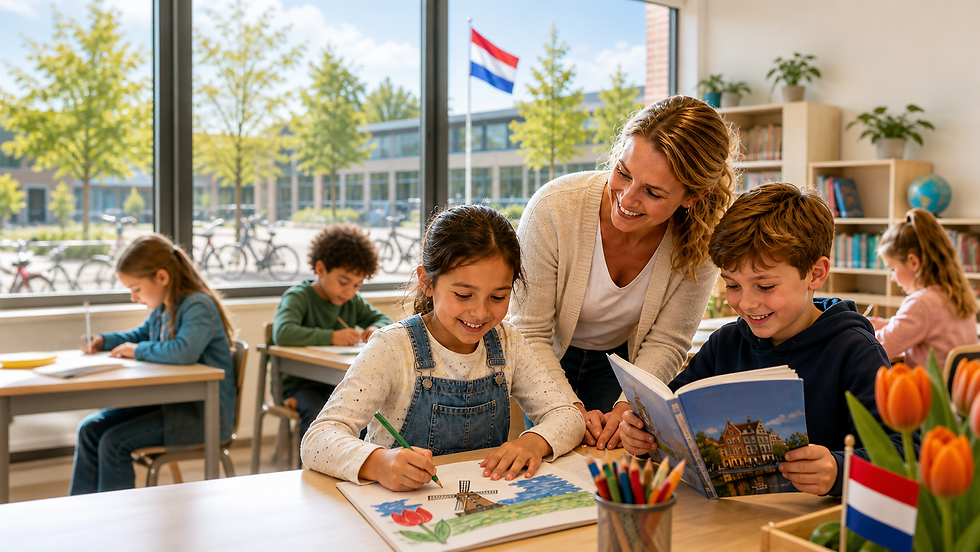
Choosing a school in the Netherlands should not be based only on popularity, location, or online reviews. The right school depends on the child’s needs and the family’s long-term plan.
At LuzRumo, we help families compare schools through practical questions:
Will the family stay in the Netherlands long term?Does the child already speak Dutch or English?Is local integration or international continuity more important?What is the child’s age and current grade level?Does the child need language support?Is the school philosophy suitable for the child?Are there waiting lists?What are the future secondary school options?
This helps parents make a confident and realistic decision.
6. Final Thoughts
The Netherlands offers excellent primary education, but international families need to understand the structure before choosing a school. A Dutch basisschool can be ideal for long-term integration, especially for young children. A bilingual or international school may be better for globally mobile families or older children who need academic continuity.
The best school is not always the most famous one. The best school is the one that supports the child’s learning, confidence, language development, wellbeing, and future goals.
At LuzRumo, we guide families through this process with clarity, care, and professional expertise.
Contact LuzRumo today to plan your child’s educational pathway in the Netherlands with confidence.


Comments